When Vogue Korea's July 2026 issue arrived with three covers all featuring Rosé — the editorial titled 'La Rosé' and shot by Vitali Gelwich in Saint Laurent by Anthony Vaccarello — it confirmed something the fashion industry has been registering since the BLACKPINK member stepped onto the Saint Laurent runway in 2022: that Rosé is not a K-pop idol wearing designer clothes but a fully formed fashion subject who happens to make music. The Rosé Vogue Korea July 2026 cover is the clearest editorial argument for that position yet: three distinct cover treatments of the same artist by one of fashion photography's most formally precise eyes, each presenting a different facet of a persona that has become one of the most consistently well-dressed in contemporary pop culture.
THE 'LA ROSÉ' EDITORIAL: VITALI GELWICH'S PORTRAIT OF SAINT LAURENT'S MOST DEVOTED MUSE
Vitali Gelwich, the German photographer whose editorial work spans Vogue, W, and i-D and who has built a reputation for images that treat their subjects as compositional equals rather than decorative elements, shot the entire 'La Rosé' story. The result is a set of covers that feel simultaneously specific to Rosé and entirely Saint Laurent — a balance that is harder to achieve than it looks, particularly when the subject is as visually distinctive as BLACKPINK's vocalist. On the A-version cover, Rosé wears a dramatic coat over a sheer Saint Laurent skirt — a look that channels the house's Rive Gauche archives while remaining unmistakably 2026 in its confident proportions. The B-version introduces a black floral lace layer over a dark underlayer, with a golden-brown fur-look coat wrapping the shoulders and a wide black belt with an oval buckle pulling the silhouette into a precisely dramatic shape.
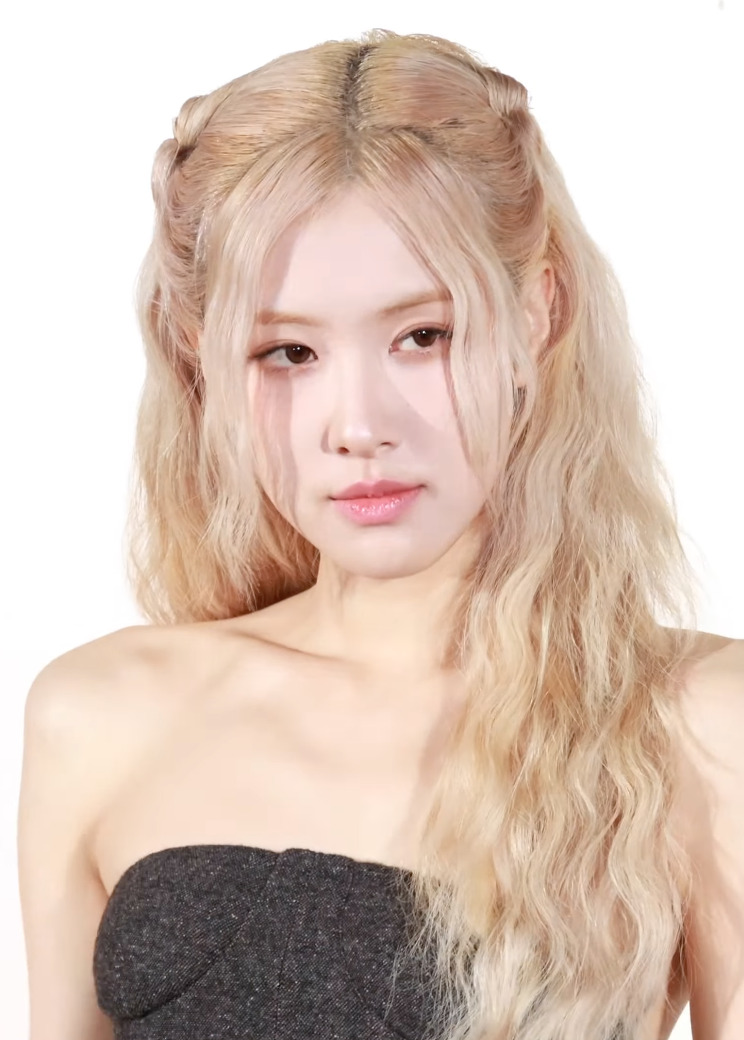
The styling across all three covers is credited to Aeri Yun, whose work with Rosé reflects a deep understanding of how to amplify Saint Laurent house codes within Korean fashion media's visual grammar — an editorial context that rewards restraint over maximalism and compositional precision over spectacle. Hair by Kim Seyoung, makeup by Won Jungyo, and nails by Betina complete a creative team that has collaborated with Rosé across multiple editorial contexts. Across all three 'La Rosé' covers, the look is unified: a pale blonde updo with short side-swept bangs, defined eyes, strong lashes, and a muted nude-pink lip that reads as both immediately modern and deeply referential to the 1970s Saint Laurent imagery that Vaccarello has spent his tenure at the house reinterpreting.
ROSÉ AND SAINT LAURENT IN 2026: AN AMBASSADOR RELATIONSHIP THAT BECAME A CREATIVE PARTNERSHIP
Rosé's relationship with Saint Laurent has evolved over four years from ambassadorship to something more integrated. She wore Saint Laurent to the 2026 Met Gala — a custom gown by Anthony Vaccarello that appeared on multiple best-dressed lists from the evening — and has been photographed in the house's collections in enough editorial contexts that the pairing has acquired a visual shorthand: Saint Laurent means Rosé, and Rosé means Saint Laurent, in a way that is genuinely rare between a K-pop idol and a single European house. The Vogue Korea July 2026 cover is the domestic version of that story: a Korean fashion magazine acknowledging, through the 'La Rosé' title and the triple-cover treatment, that the relationship has reached the stage where the artist herself is the subject, not merely the vehicle for the brand.
The July issue also includes a 12-page feature on TXT's Yeonjun — positioning Rosé's covers within a broader editorial frame that places K-pop's most fashion-forward figures alongside each other in the same issue. That placement is deliberate: Vogue Korea has become one of the most sophisticated navigators of the intersection between K-pop celebrity and global fashion credibility, and its July 2026 issue, with Rosé across three covers and Yeonjun across twelve pages, reads as a statement about where that intersection currently stands. Both have moved beyond their groups into individual creative territory that is legible to international fashion audiences with no direct relationship to K-pop as a genre.
WHAT THE ROSÉ VOGUE KOREA JULY 2026 'LA ROSÉ' COVER MEANS FOR K-POP AND FASHION
The triple-cover format is a commercial strategy as much as a creative one: three versions drive higher sales, give different fan communities a reason to collect, and generate distinct social media documentation for each look. But the 'La Rosé' designation transforms what could be a straightforward product strategy into an editorial claim. A named story — 'La Rosé,' definite article, in French — positions the subject as a singular entity worthy of a proper noun. It is the kind of naming that French Vogue might use for Catherine Deneuve or Charlotte Rampling: figures who have moved from performer to icon, from person to visual reference. For a K-pop artist — even the most internationally recognised one — it is an unusual honour, and Gelwich's photography earns the framing. The images are not fan-service or pop editorial. They are portraits.
Frequently Asked Questions
K-Pop Group Profiles